
(Read Genesis 2)
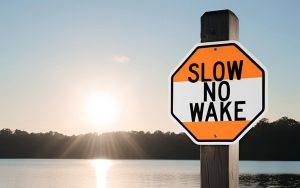 If you’ve ever spent time near the water, you’ve probably seen it too. On a quiet stretch of the bike path, I passed a familiar sign—one I’ve walked past at least a hundred times. “Slow No Wake.” Clear. Unmistakable. Commanding. That sign isn’t there for decoration—or placed on a whim. There’s nothing random about its message or its location. It’s there for a reason: the shallow, narrow canal separating two lakes, guards a fragile shoreline, nesting birds, and can’t handle heavy boat traffic.
At first, I couldn’t figure it out. Why were these words bouncing around in my brain that morning? To be clear, I don’t believe that everything is a message from God. Like a word mentioned in a song must be a signal from Him. But this felt different. Was God trying to tell me something more profound? Then, it hit me. “Slow down.”
At first, I couldn’t figure it out. Why were these words bouncing around in my brain that morning? To be clear, I don’t believe every random sight or lyric is a message from God. Not everything whispered in a song is a divine signal. But this felt different. Was God trying to tell me something more profound? Then it hit me—“Slow down.”
Rest, reset, and release are all things God calls us to through both His words and His actions. There is nothing He hasn’t already accounted for in His divine plan. He knows what we need—before we need it, when we need it, and why we need it. Like many of His instructions, it’s not about following rigid rules. It’s about what is ultimately good for us. God’s guidance often sounds like this: do this because it’s better for you now, it will matter later, and one day, you’ll be grateful you listened. Even when He doesn’t explain why, sometimes He simply says, “Trust Me.” Because He knows better.
By the seventh day God had finished the work he had been doing; so on the seventh day he rested from all his work. Then God blessed the seventh day and made it holy, because on it he rested from all the work of creating that he had done.
Genesis 2:2–3
Did God need a day of rest? I’m not convinced that the One who breathed the observable universe spanning 93 billion light-years into existence with a word needed a day off.
It’s impossible to fathom the energy expended in that moment. Physicists estimate the positive energy content of the universe at roughly 1069 joules (that’s a 1 followed by 69 zeros). Numbers like that defy explanation. And it seems unreasonable to project our human limitations onto God, as if He needed to catch His breath. Maybe we need to reconsider what God’s rest really means.
When Scripture says “God rested,” it doesn’t suggest fatigue. God ceased from His work because the work was complete, not because He was depleted. In this example of Divine rest, God set a pattern for human life: work and rest are both sacred. He established a pattern for the Sabbath, which should be a day set apart not just for inactivity, but for reflection, renewal, and communion with the Creator.
“Remember the Sabbath day by keeping it holy… For in six days the LORD made the heavens and the earth… but he rested on the seventh day. Therefore the LORD blessed the Sabbath day and made it holy.”
Exodus 20:8–11
Those who know me are likely puzzled by this week’s devotional. “That’s the pot calling the kettle black.” If anyone brushes past the fourth Commandment, it’s me. God’s word “Remember” to Moses implies more than mental recall; it’s a deliberate act of honoring. We are not just to avoid work but to set apart the day (or time) with intention. The Sabbath is a reminder of who God is and our relationship to Him.
A God-centered pause is more than a break from productivity, it’s turning away from distractions and returning to Him. The Sabbath is a time when we reorient around God’s presence and priorities. It means that we trust and show faith in God to sustain us, rather than managing on our own.
Well-known author and Pastor, John Mark Comer said it well, in his book, The Ruthless Elimination of Hurry, “Hurry is the great enemy of spiritual life in our day. You must ruthlessly eliminate hurry from your life.” His book is incredibly insightful and deeply applicable. It opened my eyes to the consequences of ignoring God’s unmistakable call to the “No Wake” zone. More importantly, Comer highlights the spiritual benefits that come when we actually heed it.
Some argue, from a legalistic standpoint, that we are required to observe our day of rest every Sunday. But what about those who work on Sundays? Taking a step back, perhaps the heart of the Sabbath is less about a specific day and more about a dedicated 24-hour period each week when we “remember… and keep it holy.” But even then, what about someone in a mission-critical role, or a soldier in combat, who doesn’t have the luxury of a full day of rest?
And he said to them, “The Sabbath was made for man, not man for the Sabbath.”
Mark 2:27
Jesus spoke these words in response to the Pharisees, who challenged His disciples for plucking grain on the Sabbath. In their view, this offensive act violated Sabbath law. But Jesus didn’t respond with a legal argument. He offered a realignment of purpose. The Sabbath is not about stressing over precision or rule-keeping. It’s a gift. God created it out of grace to refresh, restore, and realign us. It was never meant to be the rigid system the Pharisees used for their gain. God’s rest is an act of grace, woven into the very fabric of creation.
Comer wrote, “The Sabbath is a day to stop, rest, delight, and worship.”
A No Wake Zone is a designated area on the water where boats must move at very slow speeds to avoid creating waves, or “wake.” These zones are designed to protect swimmers, kayakers, and others in the water while also preventing shoreline erosion, safeguarding docks and moored boats from damage, and preserving wildlife habitats by minimizing disturbances in sensitive areas.
The key ingredient to not making wake is slowing down. When cruising at high speeds, we often miss the beautiful details of God’s creation. We become A-to-B focused, living with a point-to-point mindset. But when we move through life at full speed, the greatest loss is the glory of God’s presence. His awesomeness shifts from a relationship to a blur. And that’s not what He wants—God longs for more from us.
As a surfer, I love the power and speed of waves. But sometimes, the tranquility and peace of a quiet morning resonate more within me. No wake zones allow us to observe, pray, and listen. We were created to be all in, but also to Commune with God.
“Come to me, all you who are weary and burdened, and I will give you rest… you will find rest for your souls.”
Matthew 11:28–30
In this passage, Jesus invites us to see Him as a new way of carrying our responsibilities. His yoke is not a burden but a gift. It is a tool of grace, and He carries the weight with us. The rest He offers goes beyond relief, it offers a new rhythm for life. It is reorientation.
God commanded us to take a day of rest, not because He needs it, but because we do. He is not interested in the numbers in our bank account, our sales goals, our fitness stats, or the size of our social circle. He wants our hearts. He longs for the relationship He once had with Adam and Eve to be restored in each of His children.
Sabbath is not about checking out. It is about tuning in. Jesus modeled this. He made time to withdraw, to reconnect with the Father, to regain clarity, and to invite others into an unhurried state. So slow down. Notice what God has made around you. Be grateful. Speak to Him. Instead of stirring the waters, allow yourself to move gently through them. Let your soul settle. Embrace the calm He offers.
“Be still, and know that I am God.
I will be exalted among the nations,
I will be exalted in the earth!”
Psalm 46:10
Key Application:
- Embrace rest in the way God designed it for us. Regular rest is not a sign of weakness or laziness. It’s obedience. Set aside time each week or each day to step away from striving and reconnect with God. Slow down to reflect on His goodness and cultivate gratitude.