
(Read Psalm 130)
 Every morning before I open a single email, I sit with God’s Word — no phone, no news, just me, my Bible, and whatever He wants to say.
Most mornings, something lands. This particular morning, it didn’t.
I was reading Psalm 130 — one of the seven Songs of Ascent, a short lament that pivots hard toward hope. It’s a beautiful psalm with rich theology, and I felt absolutely nothing. I was distracted, going through the motions, like I was reading the back of a cereal box.
I closed my Bible, genuinely disappointed in myself. Was it a lack of focus? A hardened heart? Probably both. I moved on and picked up my devotional — a book a friend had given me for Christmas.
You can probably guess where this is going. The devotion for that morning was also on Psalm 130, the exact same passage, word for word.
I just sat there. My first instinct was to chalk it up as a coincidence — what my wife would call serendipity. She loves that movie. I used to love the idea of happy accidents, too. But I’ve lived long enough and walked close enough with God to know: He doesn’t do accidents.
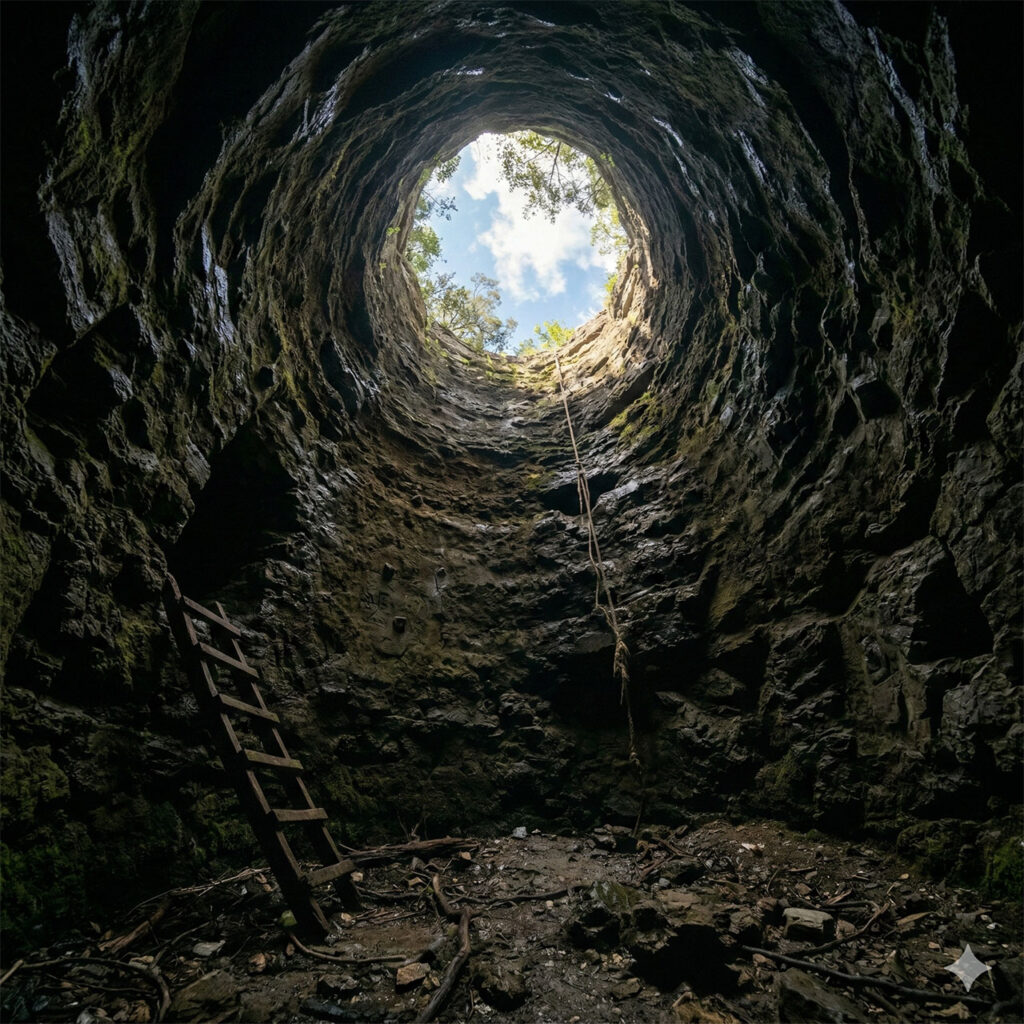
He was dangling a rope. And He wanted me to grab it.
Out of the Depths
Out of the depths I call to you, Lord! Lord, listen to my voice; let your ears be attentive to my cry for help.
— Psalm 130:1-2
The Psalmist opens from a pit — not a bad day, but an actual pit. Anyone who has lived long enough knows exactly what that feels like: the grief, the failure, the regret, the weight that settles on your chest at 2 AM when the world is quiet and your mistakes are loud.
But this particular pit isn’t the result of someone else’s cruelty. It’s self-inflicted. The Psalmist is crying out from the consequences of his own sin. And if you’ve ever been there — really been there — you know there’s nothing lonelier than that specific kind of darkness.
Oliver Hardy used to say, “This is a fine mess you’ve gotten us into.” It’s funny in a comedy sketch, but not so funny when it’s your actual life.
My biggest weakness isn’t alcohol or gambling or any of the things we typically associate with addiction — mine is work, which I realize sounds almost noble, but it isn’t. By the end of most weeks, I’ve spent far more time proving that work is my priority than anything else. My grandkids are bundles of joy wrapped in miniature packages. I love to fish, play disc golf, paddleboard, and read. And yet somehow, the week slips by, and I haven’t done any of it.
I love what I do, and that’s a genuine gift from God that I’m truly grateful for. But when something you love becomes something you can’t stop — even when it’s damaging your marriage, your health, your family — it stops being a gift and becomes an idol. That’s my pit, and I own it.
Waiting in the Dark
I wait for the Lord; I wait and put my hope in his word. I wait for the Lord more than watchmen for the morning — more than watchmen for the morning.
— Psalm 130:5-6
The night watch was real work in ancient Israel. Guards posted at the city walls, staring into darkness, waiting for dawn. Every minute felt slow. Every sound suspicious. But they weren’t waiting without hope. They knew the sun was coming. They’d seen it rise before.
That’s the posture of Psalm 130 — not despair, not denial, but watchful waiting with confident hope.
When I call out to God about my work addiction, I’m not crossing my fingers anymore. I stopped knocking on wood years ago. What I have instead is something the world can’t manufacture — the quiet confidence that God hears me. That He’s already moving in the dark before the answer arrives.
He rarely answers the way I expect. But He always answers.
I’ve had friends who hit real rock bottom with drugs and alcohol — the kind that strips everything clean. And almost every one of them has said the same thing: hitting bottom was the worst thing that ever happened to them, and also the best. It was horrible, and it was also the cornerstone of their healing.
You can’t look for help until you know how badly you need it. The bottom of the pit is actually a surprisingly good place to look up.
The Rope That’s Always There
Israel, put your hope in the Lord. For there is faithful love with the Lord, and with him is redemption in abundance. And he will redeem Israel from all its iniquities.
— Psalm 130:7-8
Here’s what I’ve learned about my secrets: keeping them private doesn’t protect me. It connects me to them.
We think hiding our struggles puts them in a safe place. But what it actually does is anchor them to us. Every unconfessed sin, every unspoken shame — they don’t disappear into a safe place. They anchor themselves to us and pull us steadily downward into the dark.
Opening up our hands and turning our burdens over to God isn’t weakness. It’s the only smart move available. The Psalmist didn’t encourage Israel to work harder and figure it out. He encouraged them to go public with their need — to let God into the mess.
Psalm 130 is classified as a penitential psalm — an expression of sorrow for sin — and yet it doesn’t end in despair. It ends in redemption, with the final word being rescue rather than shame.
Is it a coincidence that “Redeemer” is one of Christ’s names? I don’t think so.
“I am making everything new.”
— Revelation 21:5
That promise is not just for eternity. It’s for today. For the pit you’re in right now. For the rope hanging right in front of you.
The rope is always there. The question is whether we reach for it.
A Word Before You Go
Most of the holes we find ourselves in, we dug ourselves. That’s the honest truth. And it stings a little. But the Psalmist knew it too — and he cried out anyway. He didn’t wait until he was cleaned up. He cried from the bottom.
God met him right there at the bottom, and He’ll meet you there, too.
I know I was meant to sit with Psalm 130 that week. Two encounters in one morning weren’t a coincidence. It was a message with my name on it. God dangled the rope. I just needed to stop pretending I didn’t need it.
Until Christ returns, we will always be people who are waiting. Watching the horizon like the night watchmen. Hoping in a Word that has never once failed.
The end of the rope stops in the palm of God.
— Dillon Burroughs
Key Application:
- Read Psalm 130 a few times this week. It’s short — only eight verses. Ask yourself honestly: what’s the pit in your life right now? Have you been trying to climb out on your own? Self-help has its limits. Reach for the rope.