
(Read John 10)
The LORD is my shepherd; I shall not want.
He makes me lie down in green pastures.
He leads me beside still waters.
He restores my soul.
He leads me in paths of righteousness
for his name’s sake.
PSALM 23:1-6
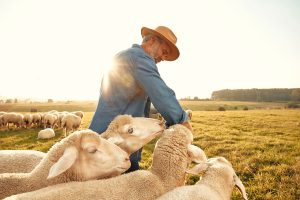 What does it mean to have someone who will always protect us, guide us, and look out for our best interests even when wandering astray is our own fault? Most of us would probably donate organs to family members or even close friends and, if pushed to the brink, would even die for family. But how many of us would die for a friend, acquaintance, or stranger?
The absolute truth is that God (as our Shepherd) is our protector. He provides. There are no wants in life that He won’t supply for us. In Psalm 23, King David conveyed God’s fatherly love for His flock. God provides for our needs, our rest, our calm, our restoration, and a path to righteousness in His name. David reflects complete trust in God’s sufficiency in supplying all his wants.
This psalm also beautifully illustrates the intimate relationship between the shepherd and the sheep, symbolizing God’s deep care for His people. Sheep depend entirely on their shepherd for guidance, provision, and protection, just as we wholly rely on God. The imagery of green pastures and still waters portrays not only physical sustenance but also spiritual refreshment and peace. Even in the darkest valleys, where fear and uncertainty loom, God’s presence offers unwavering comfort and security. His rod and staff remind us that He defends us from harm and gently directs us back to His path when we stray. Through this metaphor, David emphasizes that God’s care is tender and powerful, ensuring our closeness with Him in every circumstance.
“The thief comes only to steal and kill and destroy; I have come that they may have life, and have it to the full.
I am the good shepherd. The good shepherd lays down his life for the sheep. The hired hand is not the shepherd and does not own the sheep. So when he sees the wolf coming, he abandons the sheep and runs away. Then the wolf attacks the flock and scatters it. The man runs away because he is a hired hand and cares nothing for the sheep”.
John 10:10-13
Jesus calls Himself the Good Shepherd to underscore the depth of His love, His intimate knowledge of, and unwavering commitment to His followers. This passage is a profound model for Christian understanding, obedience, and worship. By describing Himself in this way, Jesus establishes Himself as the ultimate example of selfless love and sacrificial care. Unlike a hired hand who acts out of self-interest, He willingly lays down His life for His sheep—a level of commitment and love beyond anything we can fully grasp. And who are these sheep? We are. Despite knowing better, we still stumble into the same traps, straying from the path of righteousness time and again.
When the Gospel of John was originally written, it did not include the chapter and verse divisions we see today; those were added in the 16th century to assist with study and reference. Recognizing this helps us see the thematic connection between John 9 and John 10. Although they now appear as separate chapters, they form a continuous narrative. Before introducing the Good Shepherd metaphor, Jesus miraculously healed a man born blind—an act that outraged the Pharisees because it was performed on the Sabbath. Nevertheless, this display of compassion and divine power highlighted Jesus’ authority and mission.
Scholars debate the identity of the “thief” Jesus refers to in this passage. Some point to Satan, while others argue He is calling out the Pharisees. In truth, it can be both. The Pharisees worked tirelessly to undermine Jesus’ mission, ultimately conspiring in His crucifixion. Meanwhile, Satan’s goal is always to steal, kill, and destroy, employing anyone—from influential religious leaders to everyday individuals—to accomplish his ends. Regardless of the interpretation, the lesson remains clear: whoever aims to separate the sheep from the Shepherd aligns with the destructive purposes of the enemy.
Fearful of losing their grip on authority and clinging to a rigid interpretation of Mosaic Law, the Pharisees felt threatened by Jesus. Instead of celebrating the blind man’s healing, they condemned Jesus for violating Sabbath rules, revealing their deep-seated hypocrisy. Jesus did not hesitate to confront this double standard, exposing their hardened hearts for all to see. By pairing His miraculous healing with the Good Shepherd analogy, Jesus reveals Himself as the ultimate healer—of both physical and spiritual blindness—and the compassionate leader who exposes corruption to guide His flock into truth.
Then the word of the LORD came to me saying, “Son of man, prophesy against the shepherds of Israel. Prophesy and say to those shepherds, ‘Thus says the Lord GOD, “Woe, shepherds of Israel who have been feeding themselves! Should not the shepherds feed the flock?”
Ezekiel 34:1-2
Going back in the Bible to Ezekial’s time, we see God’s unmasked, seething anger at Israel’s leaders. The Israeli leaders were also labeled metaphorically as “shepherds.” These leaders—kings and priests were entrusted with the care and well-being of God’s people. Instead of fulfilling their responsibilities with selflessness and dedication, they exploited their position for personal gain, neglecting and oppressing those under their care.
The leaders were focused on their own gain and comfort, exploiting the flock for their own benefit rather than serving and caring for them. This highlighted their selfishness and disregard for their responsibilities. God pointed out that they were not feeding their flock, exposing their core failure as shepherds. They failed to provide spiritual nourishment, guidance, and protection, leaving the flock vulnerable and scattered.
Later, in Ezekiel 34, God contrasts these corrupt leaders with Himself — a different kind of shepherd who will personally rescue, care for, and restore His flock. This foreshadows the coming of Jesus, the Good Shepherd, who fulfills this divine promise.
“I am the good shepherd; I know my sheep and my sheep know me— just as the Father knows me and I know the Father—and I lay down my life for the sheep. I have other sheep that are not of this sheep pen. I must bring them also. They too will listen to my voice, and there shall be one flock and one shepherd. The reason my Father loves me is that I lay down my life—only to take it up again. No one takes it from me, but I lay it down of my own accord. I have authority to lay it down and authority to take it up again. This command I received from my Father.”
John 10:14-18
Sheep were typically kept in a pen with a single door as the entry and exit point. Anyone seeking to harm or steal the sheep would avoid using the door, attempting to enter by another means. In contrast, the true shepherd enters through the door, recognized and trusted by the doorkeeper. This imagery aligned with Ezekiel’s message and also served as the backdrop for Jesus’ teaching, emphasizing His role as the Good Shepherd who protects and cares for His flock while exposing corrupt and self-serving leaders as false shepherds.
Jesus describes Himself as both the “Gate” (or “Door”) to the sheepfold and the One who gives life “more abundantly.” These statements introduce His protective and nurturing roles. He contrasts Himself with false shepherds (thieves, robbers) who exploit the sheep. Our relationship with Him is one of deep, mutual knowledge and hope. The comparison “just as the Father knows me and I know the Father” elevates the intimacy between Jesus and us. It mirrors the perfect unity and love within the Godhead.
“And I have other sheep that are not of this fold. I must bring them also, and they will listen to my voice. So there will be one flock, one shepherd.” Other Sheep is commonly understood to refer to Gentiles (non-Jewish people) who will also come to believe in Christ. Jesus’s mission extends beyond the Jewish community to the four corners of the Earth, fulfilling God’s promise to bless “all nations” (Genesis 12:3). This unity is grounded in recognizing Christ’s voice and following Him.
The Father’s love for the Son is interconnected with the Son’s obedience and sacrificial work on the cross. Only one man’s works throughout eternity ever earned Salvation—that was the saving work of Jesus Christ on the cross. The Father’s love isn’t earned by any of our sacrifices; rather, Jesus’ words in John’s Gospel highlight the unity of purpose between the Father and Son’s redeeming work.
Jesus mapped out the connections between us, other followers, and God using the sheep, flock, and shepherd illustration. The closer we stay to Jesus and the unity of His flock, the less power the thief has over our lives. What is the Good Shepherd’s will for our lives? We should read the Bible daily, become more like Christ through faith, love, and obedience to God’s word, and align our lives with Jesus Christ.
The shepherd of the sheep is allowed to come in the door. What is that? That’s privilege, right, authority, ownership. The guard is not going to let anybody but the shepherd in. And this is to indicate to us that Christ is the rightful Shepherd of His sheep. He has the privilege to come in and call His sheep and take them out. He has fulfilled all Messianic prophecy. He has demonstrated by words and works that He is the Messiah, the Son of God.
John Macarthur
Key Applications:
- Stay Close to the Shepherd. Sheep are safest when they stay close to the shepherd. Straying from His guidance leaves us vulnerable to life’s challenges and spiritual deception.
- Discern False Influences. Jesus contrasts Himself with hired hands and thieves who do not genuinely care for the sheep. Be discerning about whom we follow and avoid influences that lead us away from Christ’s truth and care.
- Celebrate Unity in the name of Christ. Jesus speaks of having “other sheep” not of the current fold. This teaches us to embrace others within the body of Christ and work toward unity, even if they look and think differently than we do. Recognize that all who truly follow Jesus are part of His flock. It’s not up to us to judge.