
 There is a kind of strength we admire in people, and a different kind we can only receive.
We know the first kind well. It is the strength to show up when you would rather withdraw. The strength to do the next right thing when you are tired. The strength to care for a loved one through doctor visits, late-night phone calls, and long seasons of uncertainty. This strength is real, and by God’s kindness it often grows through practice, community, and wisdom.
But there is another kind of strength, and it is the kind Paul prays for in Ephesians 3. It is spiritual strength. Inner strength. A strengthening that reaches deeper than personality or grit. It is not manufactured. It is given.
In the early days, it was customary for Jewish people to pray standing. Kneeling, by contrast, was a major sign of humility. When you kneel, you are saying something with your body that your heart may still be learning: I am not self-sufficient. I am not in control. I need help from Someone greater than me. And that is where Paul begins.
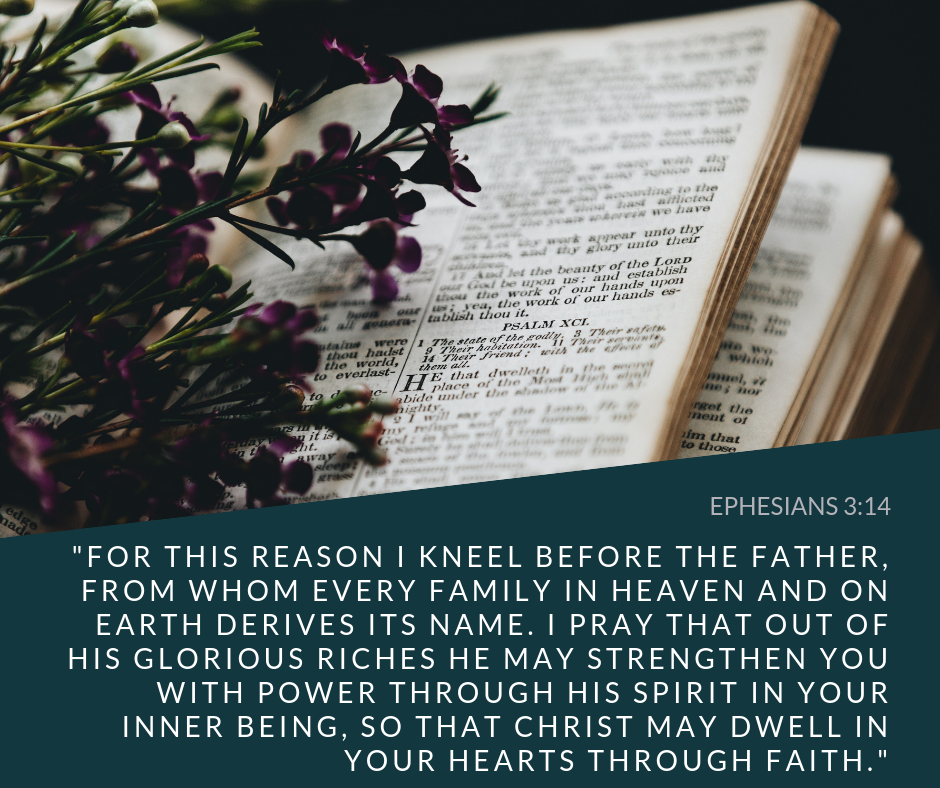
For this reason I kneel before the Father, from whom every family in heaven and on earth derives its name.
Ephesians 3:14–15
Paul is writing to believers who are learning how to live as God’s people in a complicated world. He has taught them, challenged them, reminded them of the gospel, and then he does something both simple and profound: he prays as a necessity, rather than a formality. He kneels to confess the truth: things we can do for ourselves, and things we cannot. That difference becomes painfully clear when we lose someone we love.
A very close and dear friend of mine lost her father this week. He struggled with health issues recently and has gone to be with Jesus. My friend and her husband are strong believers in God. I know they are reassured by an eternal relationship with Him, and I also know their pain and sense of loss is very real.
Faith does not erase grief. It redefines it. Christian hope is not denial. It does not pretend the chair at the table is not empty. It does not rush past tears or speak in clichés. Hope tells the truth and then insists the truth is not finished being told.
Scripture does that for us, too. Jesus Himself did that at the grave of Lazarus. Even knowing He would raise His friend, Jesus still entered the sorrow of the moment.
Jesus wept.
John 11:35
Those two words are a sanctuary for hurting hearts. They tell us that God is not distant from our grief. He is not irritated by it. He does not demand that we “be strong” in a way that means being unfeeling. Jesus wept. He stood in the presence of death and loss, and tears came. So when we come to God with trembling, with questions, with aching memories, we are not bringing Him something inappropriate. We are bringing Him something familiar.
That is why Paul kneels before the Father. Not because prayer requires a certain posture, but because prayer requires a certain honesty. You can pray standing. You can pray sitting. You can pray while driving on an interstate, eyes open, hands on the wheel, whispering a desperate sentence to heaven. The posture is not the point. The heart is the point.
So why do we kneel before the Father? If we are true believers, we do not need a reason. Prayer is essential for an ongoing connection with our Savior. Prayer is not an escape hatch from reality. It is communion with the One who rules reality.
And when grief comes, prayer becomes more than a discipline. It becomes breath.
Paul continues:
I pray that out of his glorious riches he may strengthen you with power through his Spirit in your inner being.
Ephesians 3:16
Notice where the strengthening happens. “In your inner being.” Grief has a way of revealing what is happening inside us. It can make the world noisy, but it also exposes the places we were holding ourselves together by sheer effort. We discover limits we did not want to admit.
That is not shameful. It is human.
And it is exactly why we must ask God for spiritual strength and faith. We cannot create this on our own. We can choose habits that place us near grace, but only God can supply what our soul needs most.
So that Christ may dwell in your hearts through faith.
Ephesians 3:17
This is not merely Christ visiting your heart, as if stopping by for a moment of comfort and then moving on. “Dwell” means to settle in. To make a home. To remain.
In seasons of loss, we may be tempted to think of God as someone we call when life breaks. But the gospel is even better than that. The Father desires more than an emergency conversation. He desires ongoing fellowship. He desires to inhabit the places grief has unsettled. He desires to live with us in the ache.
And I pray that you, being rooted and established in love…
Ephesians 3:17
Grief can make you feel unrooted. What was stable now feels shaky. What was predictable is suddenly strange. Your mind replays conversations. Your heart reaches for the familiar sound of a voice that will not answer the phone.
So Paul prays not just for strength, but for rootedness, and specifically rootedness “in love.” Not rootedness in stoicism. Not rootedness in willpower. Rootedness in the love of God.
And then he prays for comprehension from deep in his soul:
…may have power, together with all the Lord’s holy people, to grasp how wide and long and high and deep is the love of Christ.
Ephesians 3:18
Grief has dimensions, and so does love. The love of Christ is not a small blanket you tug over your shoulders to get through a hard night. It is an immeasurable reality that holds you when you cannot hold yourself. Paul is saying, in effect, that you will need more than information in your suffering. You will need to grasp love. You will need to know, not merely as a doctrine but as a lived experience, that Christ’s love reaches your lowest moment and does not stop there.
Then comes one of the most stunning lines in Scripture:
…and to know this love that surpasses knowledge…
Ephesians 3:19
There is a knowing beyond knowing. A knowledge deeper than explanations. When you have lost someone you love, you quickly learn that explanations do not heal. They can sometimes help, but they rarely mend the torn places.
What mends is presence. That is why prayer matters so much in grief. Prayer does not simply give you words to say. It places you in the presence of God. It brings you into communion with the Father who sees, the Son who weeps, and the Spirit who strengthens. Prayer is where we learn again that we are not abandoned. The prayer ends with purpose:
…that you may be filled to the measure of all the fullness of God.
Ephesians 3:19
This does not mean you become God. It means you become filled with what God supplies. In other words, when grief empties you, God can fill you. When sorrow hollows out your insides, the Lord can meet you there with Himself. That brings us to the tender question you raised: how does prayer connect us with a loved one who has gone to be with Jesus?
We have to speak carefully here, because Scripture points us to pray to God, not to the departed. But prayer can still connect us with them in real and meaningful ways.
Prayer connects us with them through shared belonging. Paul says the Father is the One “from whom every family in heaven and on earth derives its name.” (Ephesians 3:15) That is an astonishing picture. There is one family, with members on earth and members in heaven, all named by the Father. When we pray, we are not talking into a void. We are speaking as part of God’s household, joined to Christ, united with believers across time and place.
Prayer also connects us with them through thanksgiving. We bring their life before God, remembering His gifts through them. We can say, “Father, thank You for what You did through him. Thank You for the ways he loved, the ways he served, the ways he reflected Your kindness.” Gratitude does not cancel grief, but it sanctifies memory. It turns remembrance into worship.
Prayer connects us with them through hope. Scripture does not tell us not to grieve. It tells us not to grieve as those without hope.
We do not want you to be uninformed… about those who sleep in death, so that you do not grieve like the rest of mankind, who have no hope.
1 Thessalonians 4:13
Hope is not the absence of tears. Hope is the presence of a future. One day, what is now separation will become reunion in Christ. One day, God will finish what grief interrupts.
“He will wipe every tear from their eyes. There will be no more death or mourning or crying or pain…”
Revelation 21:4
Prayer becomes a bridge to that promised day. Not because prayer forces God’s hand, but because prayer aligns our hearts with God’s promises. It keeps us tethered to what is true when feelings are unstable.
Prayer also connects us with them by helping us love the people still here. When someone dies, grief can make you withdraw. It can also make you cling. Either way, prayer steadies your heart so you can be present. Your loved one’s legacy often lives on through the way you love others. Prayer strengthens you “in your inner being” so you can carry sorrow without becoming hardened by it.
And sometimes, prayer connects us with them simply by naming them before God. Saying their name in prayer is not a magical act. It is a relational one. “Father, I miss him.” “Father, comfort her.” “Father, hold this family.” These prayers acknowledge the ongoing reality of love. We do not stop loving when someone dies. Love continues, and prayer gives love a holy place to go.
Finally, Paul closes with worship that is especially fitting when we feel we have reached the edge of ourselves:
Now to him who is able to do immeasurably more than all we ask or imagine… to him be glory… forever and ever! Amen.
Ephesians 3:20–21
Grief makes our world feel smaller. It can make us think in short phrases and small hopes: get through today, survive this week, make it to the next family gathering. God is kind to meet us even there. But Paul reminds us that our God is able to do more than we ask, more than we imagine, more than we can currently see.
So for this reason we kneel.
We kneel because strength is needed. We kneel because love must be grasped. We kneel because pain is real. We kneel because hope is truer still.
And whether your knees touch the floor or not, let your heart do what Paul’s heart did: come low before the Father, and ask Him to give what only He can give. The One who names every family in heaven and on earth is listening. The Savior who wept at a graveside is near.
The Spirit who strengthens the inner being is at work. So pray. In sorrow. In faith. In honesty. And when the ache returns, pray again.
Life Application:
- Choose a “kneel moment” each day this week (60–90 seconds), and use it as your practical response to grief and stress:
- Pray Ephesians 3:16–17 in your own words: “Father, strengthen my inner being by Your Spirit.” Name your loved one and your honest emotion (miss them, anger, gratitude, numbness). Do it daily, whether you feel “spiritual” or not. The point is not the posture—it’s returning to the Father for the strength you can’t generate on your own.