
(Read John 15)
 When I read the Bible, I must remind myself that it’s written from God’s perspective, not mine. The messages in God’s word are there for me to bear fruit to advance God’s kingdom, not my own. I have to pause while reading the Good Book and turn my understanding upside down to really discern what God’s saying to me. Like Jonah, when he rebuffed God’s initial command to preach to the Ninevites, I sometimes question, is God really saying this? Does he want me to do this?
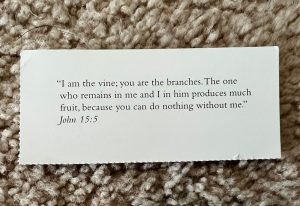
Initially, I wasn’t sure of my topic for this week’s Devotional. I have a few interviews lined up in the future, but they still need to be scheduled. In His infinite wisdom, God put a gem in front of me at the perfect time. I was cleaning my office before work this morning and bent down to pick up a piece of paper on the floor. When I turned it over, I noticed it was a memorization card from our Life Group. “Bob’s your uncle,” I thought. (Google it.)
“I am the true vine, and my Father is the vinedresser. Every branch in me that does not bear fruit he takes away, and every branch that does bear fruit he prunes, that it may bear more fruit. Already you are clean because of the word that I have spoken to you. Abide in me, and I in you. As the branch cannot bear fruit by itself, unless it abides in the vine, neither can you, unless you abide in me.
John 15:1-4
Jesus and His disciples were in a quiet upper room for His farewell discourse on the eve of His crucifixion. To the crowds, Jesus often spoke in parables. To His disciples, though, He was usually more direct. Either teaching with exactness or metaphors, He knew the meaning and intent of His message would not be lost on this intimate audience. For this occasion, Jesus chose the brevity of a metaphor, taking a complex idea and comparing it to something familiar. He didn’t need or have time to tell a long story; His followers required truth. Just the facts.
God always speaks to us in ways we can understand. Contrary to what atheists claim, the Bible wasn’t written using simple explanations to describe a narrative; it was written to be understood no matter what time period the readers are in. The concepts of the Bible are timeless, and so are the literary methods God used to illustrate His stories. So, it shouldn’t surprise us that Jesus uses the metaphor of a gardener (vinedresser) to His disciples. Gardening was as familiar in Biblical times as in the 21st century.
God, the vinedresser, carefully tends to His plants, pruning and nurturing them to ensure they bear fruit. Removing dead, diseased, or damaged branches helps prevent the spread of illness or infestation to healthy parts of the plant. We are pruned to encourage new growth. Removing unproductive, weak branches allows the plant to focus on growing new, stronger shoots and fruits. Pruning enables the gardener to control the shape of a plant. With unproductive branches removed, a plant can focus on producing better fruits. Pruning is as beneficial for the plant as it is for those around it.
I am the vine; you are the branches. Whoever abides in me and I in him, he it is that bears much fruit, for apart from me you can do nothing.
John 15:5
The disciples knew this well, but as the vine, Jesus was clearly understood as the source of life, nourishment, and support. What they might not have known at the time was that as branches, they had one purpose: to bear fruit. We are not capable of spiritual growth or good works on our own. Fruitfulness comes through a deep connection with Jesus.
Tim Keller wrote, “You don’t realize Jesus is all you need until Jesus is all you have,” which sums up our role as branches pretty well. Branches are always reaching towards the sun, with lifeblood flowing from Christ, nourishing us and enabling us to bear fruit. We are dependent on the vine for our very existence.
Abiding in Jesus and Him abiding in us is a two-way relationship. John used the Greek word “μένω (men-o)” for abide, which means to remain or stay. We should view our relationship with Jesus as a fixed state in that once connected, we’re always connected with Him. By abiding in Him, we have intimacy, dependence, assurance, endurance, and permanence.
Remaining in Christ will fulfill His promise of bearing “much fruit.” This fruit refers to the visible manifestations of a transformed life—love, joy, peace, patience, kindness, goodness, faithfulness, gentleness, and self-control (Galatians 5:22-23). These are not produced by our own efforts but by the Holy Spirit, who produces the fruit in us. Like the vine reaching for the sun, as we reach for God, He draws near to us.
My beloved had a vineyard
on a very fertile hill.
He dug it and cleared it of stones,
and planted it with choice vines;
he built a watchtower in the midst of it,
and hewed out a wine vat in it;
and he looked for it to yield grapes,
but it yielded wild grapes.
Isaiah 5:1b-2
Speaking of metaphors, in the Old Testament, the vine represented Israel. The beautiful garden imagery used by the Prophet Isaiah is tarnished by Israel’s failures to produce fruit. Out of His abundant love, God did all this amazing preparation for His garden only to see destruction and willful neglect in the harvest of “wild grapes.” The Hebrew used here (which literally meant stinking things) describes the moral and spiritual state of the people of Israel. Isaiah reflected Israel’s moral corruption, unfaithfulness, and God’s subsequent disappointment.
While cutting the lawn yesterday, I listened to a podcast interview between Gad Saad and Joe Rogan. Saad is a Canadian Doctor of Evolutionary Psychology and a Lebanese Jew. He asked Rogan about his faith, and I heard a similar post-modern explanation to the one he usually replies with. Rogan has about 14.5 million listeners around the world. Love him or hate him, virtually everyone knows his name.
When I picked up the prayer card this morning and turned it over, exposing John 15:5, I thought, “OK God, what are you trying to tell me?” Nothing at first. Then, while running, it hit me like a brick wall. “He it is that bears much fruit, for apart from me you can do nothing.” What is fruit, I wondered? Whose fruit? Rogan has millions of listeners, worldwide fame, and lots of money. I imagine he’s happy with his life, but is he bearing fruit? For himself and his family — absolutely. For God and His kingdom, I don’t know.
Norma Marie Talmadge was a prominent American actress during the silent film era. She became one of the most popular and influential figures in early Hollywood cinema and was a huge box office draw. Talmadge gained widespread acclaim for her drama performances and was known for her beauty and emotional expressiveness. Despite her stardom and fame, the advent of sound in cinema marked a decline in Norma’s career. Like many silent film stars, she struggled to transition to “talkies,” and her film appearances became less frequent.
Corrie ten Boom was the youngest of four children born to Casper and Cornelia in the Netherlands. Her family lived a simple lifestyle in Haarlem, Netherlands, where her father, Casper ten Boom, operated a watchmaking business and supported a large household, including her siblings and several aunts who lived with them. During the Nazi occupation of the Netherlands, Corrie and her family, including her sister Betsie, used a hidden room above their watch shop to shelter Jews escaping persecution. They risked their lives to hide hundreds of people over a two-year period. In 1944, their efforts were betrayed, and the family was arrested.
Corrie and Betsie were sent to the Ravensbrück concentration camp. Sadly, Betsie and other members of her family died at the camp just days before Corrie’s release in December 1944. Following the war, Corrie dedicated her life to sharing her story and message of forgiveness. She traveled the world as an evangelist and motivational speaker. Corrie ten Boom was a devout Christian, her faith (fruits) played a central role in her decision to help others and her ability to forgive those who persecuted her.
Only God knows what’s people’s hearts and how they worship, if they do. It’s not my place to insinuate that Rogan, Norma, or anyone else only bear fruit for their benefit. But for those who achieve fame and fortune, I wonder if their fruits applied for the eternal? Will anyone remember their work 100 years in the future without searching the internet? Did their work serve God and make His creation a better place? We can toot our own horns regarding our success, but we should always look deeper. Did God put us in the place and give us the tools and opportunity to make it happen? There are many things we can claim to be of our own doing, but fruits for God’s people and His kingdom can only come from Him. There is only one way we can gain Salvation, and that’s His doing.
Jesus clearly states, “Apart from me, you can do nothing.” This is a humbling reminder of our dependence on Him. We often try to achieve things through our own strength and wisdom, but true fruitfulness comes only from abiding in Christ. Recognizing our dependence on Him shifts our perspective from self-reliance to God-reliance, leading to a life marked by trust and surrender.
If you abide in me, and my words abide in you, ask whatever you wish, and it will be done for you. By this my Father is glorified, that you bear much fruit and so prove to be my disciples.
John 15:7-8
Key Applications:
- The key to fruitfulness is “abiding” in Christ. This means cultivating a deep and ongoing relationship with him. Prayer, Bible study, conversations with mature believers, and worship can help you connect with God.
- Prayer isn’t just about making requests; it’s also about listening to God. Spend time reflecting on scripture and allowing God to speak to your heart.
- We are dependent on God’s grace and strength to bear fruit. Pray for God’s help and trust that He will empower you to live a life that bears good things for Him.
Where else in your life can you live out the teachings of Christ? Look for next week’s Devotion.