
Sermon of the Known God
 (Read Acts 17)
Many events take place in chapter 17 of Acts. Luke captured all the historical details to describe what took place with Paul in Athens. More importantly, he captured the necessary details to show us the proper way to spread the gospel to an audience of mixed believers.
While Paul was waiting for in Athens, he was greatly distressed to see that the city was full of idols. So he reasoned in the synagogue with both Jews and God-fearing Greeks, as well as in the marketplace day by day with those who happened to be there.
Acts 17:16-17
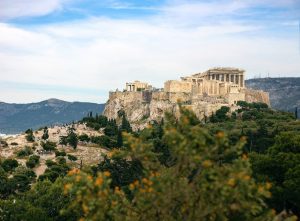
Athens, like modern day New York City, Dubai, Rome, or Paris was a spectacular city. The larger than life structures were magnificent. Paul wasn’t impressed. Paul noticed that while exceptional, Athens was filled with idols and shrines. Roman writer Petronius commented satirically that it was easier to find a god than a man in Athens. That’s god with a small “g.” Consider how differently the average tourist might have viewed Athens contrasted with Paul’s reaction. Paul witnessed a citadel of gentile self-glory but his holy heart was disgusted. He was provoked. Did he take a sledgehammer to the idolatry? Did he condemn them? He was far more concerned with removing the worship of idols in their hearts over the physical structures of gods and idols.
Tim Keller said, “Look at whatever buildings in your city are the biggest — those usually indicate the idols.” I remember the first time I visited Las Vegas. Flying in from the east, our plane was on a path nestled within a channel between two mountain ranges. Suddenly, out of nowhere was this giant, sprawling, electric city. At night, it was especially vibrant and exciting. Dancing neon lights, people laughing, and showy displays of wealth everywhere. On our first morning, I set out to sneak in a short run before we embarked on our day’s journey to visit various canyons and national parks.
Running down the streets, I saw the dark underbelly of a large modern city. There was trash blowing down the streets, broken down buildings, and ads for strip clubs in the immediate presence of school bus stops. I apologize for singling out Las Vegas, it’s a city like many in our world, but the stamp of sin and idolatry left an impressionable mark in my mind.
Paul then stood up in the meeting of the Areopagus and said: “People of Athens! I see that in every way you are very religious. For as I walked around and looked carefully at your objects of worship, I even found an altar with this inscription: to an unknown god. So you are ignorant of the very thing you worship — and this is what I am going to proclaim to you.
Acts 17:22-23
Meeting People Where They Are
It’s interesting to note that Paul’s speech consists of just 11 verses, yet it has intrigued scholars and theologians for centuries. Paul was a novelty or maybe somewhat of a celebrity in Athens. He was invited to preach at the intellectual center of the city, the Areopagus. Imagine this, Paul, a legalistic Jew smack dab in the middle of polytheistic Gentiles.
Paul didn’t beat his audience over the head with religious intellectualism. When speaking with a blended audience, or someone who is not from your same background, you want to speak in the most disarming way while still upholding the truth. He held his audience’s attention by making his message personal. Paul even quoted from their own literature.
The sermon Paul gave to the philosophers in Athens has been labeled the, Sermon of an Unknown God. Paul had seen inscriptions of Unknown Gods throughout the city. He carried on. In every city he traveled, Paul never backed off or softened his message no matter the pressure he faced. Nonetheless, he continued preaching boldly knowing the dangers he faced.
“The God who made the world and everything in it is the Lord of heaven and earth and does not live in temples built by human hands. And he is not served by human hands, as if he needed anything. Rather, he himself gives everyone life and breath and everything else. From one man he made all the nations, that they should inhabit the whole earth; and he marked out their appointed times in history and the boundaries of their lands.
Acts 17:24-26
Believe it or not, Athenians, Romans, Jews, and even contemporary Americans are similar in terms of how we view others compared to ourselves. The Greeks viewed the world as Greek or barbarian, Romans grouped people as citizens or non-citizens, and Jews classified people as Jews or Gentiles. With his message, Paul attacked the exclusiveness of every major civilization. He pointed out that God affirms the oneness and brotherhood/sisterhood of the whole human race.
“Eve was the mother of all living” (Genesis 3:20); No matter how history records things, mankind is descended from a single ancestor. So in actuality, and in the eyes of God, we are one race, one family, and one blood.
Paul goes on to drive the point home, that the one true God is so much larger than their idols. False religions and idolatry shrinks the real nature of God. For practical purposes, God is reduced to a size that can be explained and even exploited for personal gain.
“Therefore since we are God’s offspring, we should not think that the divine being is like gold or silver or stone — an image made by human design and skill. In the past God overlooked such ignorance, but now he commands all people everywhere to repent.
Acts 17:29-30
As I’m writing this devotional, the country of Afghanistan is being torn apart once again. A nation of cultures and tribes face an uncertain and more violent future. Many other countries have tried to shape Afghanistan into something in their own image. Internally, the Taliban have their own view of a righteous society. It’s the “us vs. them” erupting all over again. Too many times, mankind puts its self-proclaimed divinity over the One who is truly divine.
Paul didn’t use the expression, but he could have said, “Don’t place the created higher than the Creator.” When glory goes to us, what does God get? It would be like praising a clay pot for being so beautiful. God made us the way we are to glorify Him, not us.
I have no doubt that this experience in Athens led to what Paul wrote in Romans, “So they worshiped and served the things God created instead of the Creator himself, who is worthy of eternal praise!” (Romans 1:25)
Paul was emphasizing to his audience to stop turning stuff into God. We do the same thing. Our careers, our social status, our families, our successes are all blessings from God, but they are not God. Paul was respectful and gentle in his call to his listeners, while at the same time challenging them to be different from the world. That was no easy task for a city like Athens.
Making sure we recognize God for who He is supposed to be is a matter of perspective and proportion. “If God were small enough to be understood, he would not be big enough to be worshipped.” (Evelyn Underhill)
Key Applications:
- The next time you visit a large, spectacular city or even if you live in one, imagine yourself above it looking down. Soak in the beautiful sights. Look at the splendor below. Now, realize that you still need to look up at the Divine God who created this magnificent city and the magnificent people who dwell there. As great as our accomplishments are, they pale compared to what God has done. They pale compared to what God’s kingdom is like in Heaven. Pray about that for a moment.
- When talking to a non-believer, how do you approach sharing the Gospel? Are you sensitive to their beliefs? Try Paul’s approach. Start where they are while still upholding the truth. We don’t need a wedge to share the grace of the Gospel. We just need an opportunity.
- How can we be different from the world? We can live a life of good works. We can donate to charity, go to church, smile at everyone, but there is really only one thing that can differentiate us from the world — worshipping our true God. Pray to God. Allow Him to come into your heart and run your life.
Where else in your life can you live out the teachings of Christ? Look for next week’s Devotion.